Stillness as Medicine: Why Chasing Wellness Perfection May Be Your Deepest Imbalance

There is a particular kind of exhaustion that arrives not from neglecting one's health, but from attending to it too furiously. It is the fatigue of the person who has read every nutrition study, tracked every sleep cycle, ordered every adaptogen, and yet still wakes each morning with a quiet, gnawing sense that something remains unfinished. In Ayurvedic terms, this sensation has a name, a cause, and—perhaps surprisingly—a remedy that asks you to do considerably less, not more.
Ayurveda, the five-thousand-year-old system of medicine that originated in the Indian subcontinent, has never been particularly interested in optimization. It is interested, instead, in alignment—with one's constitution, with the season, with the natural arc of the day. These are fundamentally different projects, and confusing them may be costing Americans far more than the price of their supplement subscriptions.
The Wellness Industrial Complex and the Vata Mind
To understand why perpetual self-improvement is an Ayurvedic problem, one must first understand Vata dosha. Composed of the elements of air and ether, Vata governs movement, communication, creativity, and the nervous system. In balance, it produces enthusiasm, adaptability, and inspiration. Out of balance, it generates anxiety, scattered attention, insomnia, and a chronic sense of incompleteness—the feeling that one is always behind, always one protocol away from the life that was promised.
Now consider the texture of modern American wellness culture. Biohacking forums. Continuous glucose monitors worn by people without diabetes. Infrared saunas, cold plunges, and the meticulous logging of heart rate variability at 5 a.m. Dosha quizzes retaken monthly to see if something has shifted. The relentless consumption of content about how to sleep better, eat cleaner, think more clearly, and live longer—consumed, ironically, on the very screens that disrupt sleep, digestion, and mental clarity.
This is, from an Ayurvedic standpoint, a portrait of aggravated Vata. The irony is precise and worth sitting with: the anxiety that drives the wellness obsession is the same anxiety the obsession produces. Each new protocol introduces more variables, more decisions, more opportunities to fall short. The nervous system, already taxed, is asked to manage an ever-expanding curriculum of self-care. The result is not balance. It is a more sophisticated form of the original disorder.
What Ayurveda Actually Prescribes
Classical Ayurvedic texts, including the Charaka Samhita and Ashtanga Hridayam, spend considerable effort describing sattva—a quality of mental clarity, equanimity, and contentment. Sattva is not achieved through accumulation. It is revealed through subtraction. The ancient physicians understood that the mind inclined toward perpetual seeking—what they called prajnaparadha, or crimes against wisdom—was a mind working against its own healing.
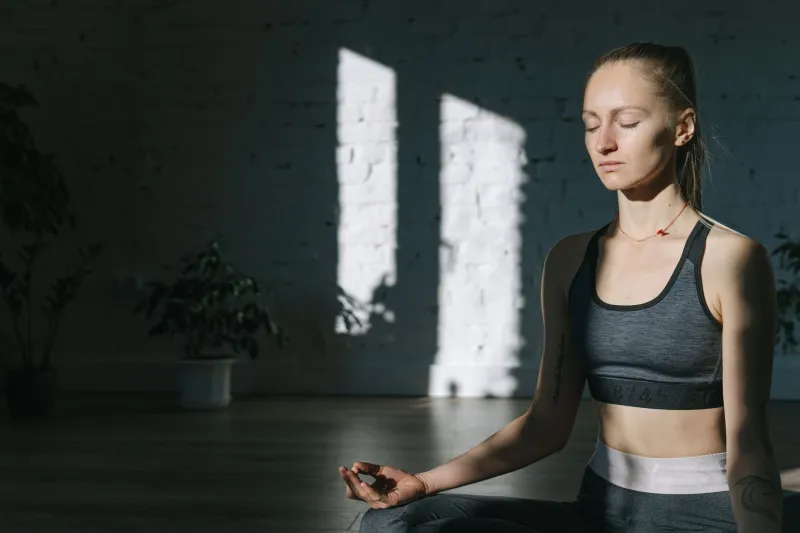
The prescription for Vata imbalance is, by design, the opposite of optimization culture. It involves regularity over novelty: waking at the same hour, eating warm and grounding foods at consistent times, retiring before ten in the evening. It involves abhyanga, the practice of self-massage with warm sesame oil—a ritual that is slow, sensory, and entirely non-productive by modern standards. It involves stillness. It involves, above all, the radical act of deciding that one is, at this moment, enough.
None of this translates well to a listicle. None of it generates the dopamine spike of a new purchase or a newly optimized morning routine. And that, of course, is precisely the point.
The Seasonal Principle: Nature Does Not Hustle Year-Round
One of Ayurveda's most elegant teachings concerns ritucharya—the practice of adjusting one's diet, sleep, and activity according to the season. In autumn and early winter, when Vata naturally predominates in the environment, the classical texts advise drawing inward: heavier foods, earlier bedtimes, reduced travel, more stillness. This is not laziness. It is biological intelligence.
American culture, by contrast, treats all seasons as equally appropriate for maximum productivity. The fourth quarter push. The New Year's resolution sprint. The summer body campaign. There is no cultural permission to slow down, and the wellness industry—despite its vocabulary of self-care—often reinforces this by simply rebranding striving as a health practice. Hustle becomes "biohacking." Restriction becomes "cleansing." Anxiety about one's habits becomes "mindfulness about optimization."
Ayurveda sees through this rebranding immediately. A person who cannot rest without guilt, who cannot spend an evening without tracking something, who experiences a skipped workout or an unplanned meal as a moral failure—that person is not well, regardless of their biomarkers. They are caught in a cycle that the tradition would recognize as a disturbance of manas, the mind, as much as of the body.
The Permission You Did Not Know You Needed
It is worth stating plainly what Ayurveda implies but rarely shouts: you are allowed to stop. Not permanently, not carelessly, but genuinely. You are allowed to eat the warm, imperfect meal without calculating its macronutrient profile. You are allowed to sleep in on a Sunday without viewing it as a failure of discipline. You are allowed to sit with your constitution—Vata, Pitta, Kapha, or some combination thereof—and recognize that it is not a problem to be solved but a nature to be understood and honored.
This is perhaps the most countercultural thing Ayurveda has to offer the American market: the suggestion that your fundamental nature is not broken. That the path to wellbeing is not an endless series of corrections but a gradual deepening of self-knowledge and self-acceptance. The Sanskrit concept of svastha—often translated as "health"—literally means "established in the Self." Not improved, not optimized. Established.
Practical Steps Toward Intentional Stillness
For those accustomed to action-oriented wellness content, a few concrete suggestions may ease the transition toward this more receptive approach.
Audit your wellness inputs. For one week, note how many health-related articles, podcasts, or videos you consume daily. Ask honestly whether this information is producing greater ease or greater anxiety. Reduction may itself be therapeutic.
Establish one unchanging anchor. Choose a single daily practice—oil pulling, a morning walk, a warm breakfast—and commit to it without variation for thirty days. Consistency, in Ayurveda, is more healing than complexity.
Practice deliberate non-tracking. Designate two days per week during which no health metrics are recorded. Observe what arises. Discomfort with the absence of data is itself diagnostic information.
Sit with incompleteness. At the end of each day, rather than reviewing what wellness goals were or were not met, simply note three things that felt nourishing. This reorients the mind from deficit to sufficiency.
Consult a qualified Ayurvedic practitioner. Rather than assembling a self-directed protocol from online sources, consider working with a trained professional who can assess your constitution and current imbalances in their full complexity. Personalized guidance reduces the noise considerably.
Closing Reflection
Ayurveda does not ask you to abandon the aspiration toward health. It asks you to examine the quality of that aspiration—whether it arises from wisdom and self-knowledge or from fear and insufficiency. The ancient physicians were not naive about human suffering or the genuine value of good habits. They were, however, deeply suspicious of the restless mind that mistakes activity for progress.
In a culture that has monetized self-improvement into a multi-billion-dollar industry, the most subversive wellness practice available may simply be this: to pause, to breathe, and to recognize that the stillness you have been running from is, in fact, the medicine you most need.