The Healing Power of Touch: Rediscovering Ayurvedic Bodywork in a Contact-Starved Culture
The human nervous system developed, over millions of years, in constant physical relationship with other human beings. Skin pressed against skin was not merely comfort—it was information, regulation, and medicine. Today, a growing body of research confirms what traditional healing systems have always maintained: that therapeutic touch is not a luxury but a physiological necessity. And yet, in the contemporary United States, meaningful physical contact has become increasingly rare, formalized, and often medicalized out of existence.
Ayurveda recognized this necessity long before neuroscience had the vocabulary to describe it. Two of the tradition's most enduring healing practices—abhyanga (medicated oil self-massage) and marma chikitsa (marma point therapy)—represent a sophisticated understanding of the body's surface as a therapeutic landscape, one that communicates directly with the nervous system, the lymphatic network, and the deeper energetic channels known as srotamsi.
Why Americans Are Touch-Starved
The United States occupies an unusual cultural position with respect to physical contact. Compared to many European and South American cultures, American social norms discourage casual touch between adults who are not intimately acquainted. Professional environments have further formalized this distance, and the social disruptions of recent years accelerated a pre-existing trend toward physical isolation.
The consequences are not trivial. Research from institutions including the University of Miami's Touch Research Institute has documented that insufficient therapeutic touch elevates cortisol levels, disrupts sleep architecture, impairs immune function, and increases susceptibility to anxiety and depression. These are precisely the conditions that Ayurvedic medicine associates with elevated vata dosha—the constitutional principle governing the nervous system, movement, and the experience of fear and instability.
In Ayurvedic understanding, the skin is not merely a barrier organ. It is the outermost expression of rasa dhatu, the first and most fundamental of the seven bodily tissues, and it is intimately connected to the heart through channels that transmit both sensation and prana (vital force). To neglect the skin is, in this framework, to neglect one of the body's primary means of receiving nourishment from the world.
Abhyanga: Self-Massage as Daily Medicine
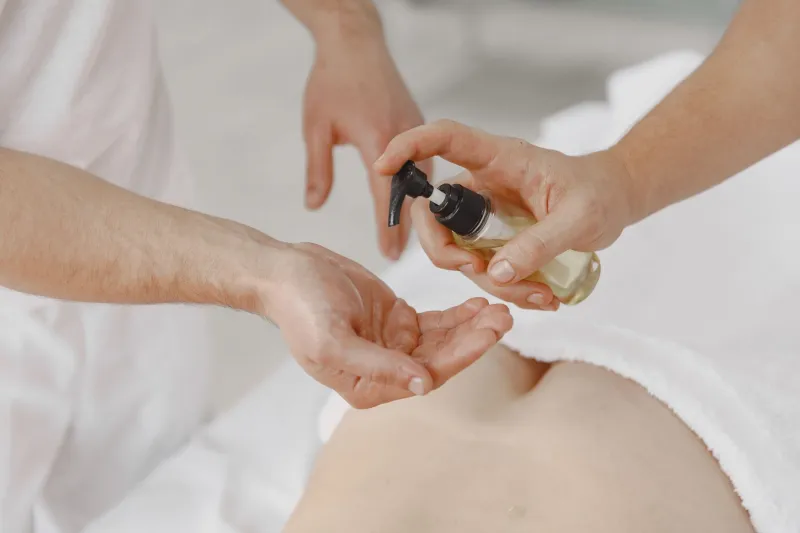
Abhyanga is the practice of anointing the body with warm herbal oil, typically performed in the morning before bathing, as part of the daily Ayurvedic routine. The word itself derives from Sanskrit roots suggesting a thorough, loving application—not a perfunctory rubbing but a deliberate act of self-care that the tradition considers as important as eating or sleeping.
The therapeutic mechanisms of abhyanga are multiple and well-articulated in classical Ayurvedic texts such as the Charaka Samhita, which states that regular oil massage produces softness and strength of the body, delays aging, bestows good vision, nourishes the bodily tissues, increases longevity, induces sound sleep, and benefits the skin. Modern physiological understanding adds further layers: the slow, rhythmic strokes of abhyanga activate the parasympathetic nervous system, lower circulating cortisol, stimulate lymphatic drainage, and enhance circulation in the peripheral tissues.
Choosing the Right Oil for Your Constitution
Oil selection in Ayurveda is not arbitrary. It follows constitutional logic:
- Vata types (characterized by dryness, irregularity, and anxiety) benefit most from warm sesame oil, which is heavy, warming, and deeply nourishing to the nervous system.
- Pitta types (characterized by heat, intensity, and inflammation) are better served by cooling coconut or sunflower oil, which tempers excess heat without aggravating dryness.
- Kapha types (characterized by heaviness, congestion, and sluggishness) respond well to lighter oils such as mustard or safflower, which stimulate circulation and counteract accumulation.
For those uncertain of their constitution, plain organic sesame oil—cold-pressed and ideally warmed before application—is considered the most universally balancing option in classical texts.
A Practical Abhyanga Protocol for Busy Americans
A full traditional abhyanga can take thirty to forty-five minutes, a commitment that may feel unrealistic in an American morning. However, even a condensed ten-minute version produces measurable benefits when practiced consistently. The following approach is appropriate for most adults:
Warm approximately two to three tablespoons of your chosen oil in a small container set in hot water. Beginning at the crown of the head (or, if you prefer to keep hair dry, at the face and neck), apply oil in long strokes along the limbs and circular motions over the joints, moving generally toward the heart. Pay particular attention to the feet, which in Ayurvedic anatomy are considered especially important for grounding vata and calming the nervous system. Allow the oil to absorb for five to ten minutes before bathing with warm—not hot—water.
Marma Chikitsa: The Body's Hidden Switchboard
If abhyanga addresses the body's surface broadly, marma chikitsa targets specific anatomical junctions where flesh, bone, vein, tendon, and joint converge in ways that Ayurvedic physicians identified as particularly potent. The classical texts enumerate 107 such points distributed across the body, each associated with specific organs, energetic functions, and physiological processes.
The concept bears a functional resemblance to acupressure and acupuncture in Traditional Chinese Medicine, though the underlying theoretical frameworks differ considerably. Where Chinese medicine emphasizes the circulation of qi through meridian channels, Ayurveda understands marma points as junctions of prana, tejas (the fire principle), and ojas (vital essence)—the three subtle energies that govern consciousness, transformation, and immunity, respectively.
In professional Ayurvedic practice, marma therapy is administered by trained practitioners and may involve gentle pressure, warm oil, specific herbal preparations, or even sound vibration. However, several accessible marma points lend themselves to informed self-application:
- Sthapani (the point between the eyebrows): Gentle circular pressure here for two to three minutes is associated with calming mental agitation and reducing tension headaches, effects consistent with stimulation of the prefrontal cortex region.
- Talahridaya (the center of each palm): Pressure applied here is linked to cardiac regulation and the release of accumulated emotional tension—a point well-known to practitioners of many touch traditions.
- Kshipra (the webbing between the thumb and index finger on the foot): Stimulation of this point is traditionally associated with respiratory clarity and the reduction of vata-driven anxiety.
Integrating Touch Rituals Into Modern Life
The greatest barrier to incorporating Ayurvedic bodywork into contemporary American life is not cost or complexity—it is the cultural discomfort with deliberate, non-instrumental self-care. Many Americans find it easier to purchase a supplement than to spend ten minutes in quiet, attentive contact with their own bodies.
Ayurveda would regard this discomfort itself as diagnostic. The tradition holds that the capacity to receive nourishment—through food, through rest, through touch—reflects the health of ojas, the subtle essence that underlies immunity, resilience, and the sense of being fundamentally well. A culture that cannot receive touch gracefully is a culture in which ojas is depleted.
Beginning a daily abhyanga practice, even briefly, is therefore not simply a physical intervention. It is a retraining of the nervous system's relationship to care—a quiet, consistent message to the body that it is worthy of attention, that slowness is permissible, and that healing does not always require effort. In a culture that has forgotten this, such a message may be among the most radical prescriptions available.